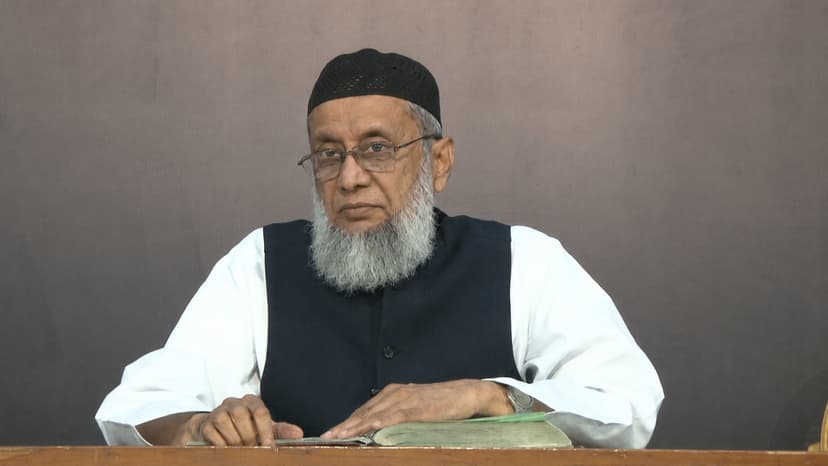
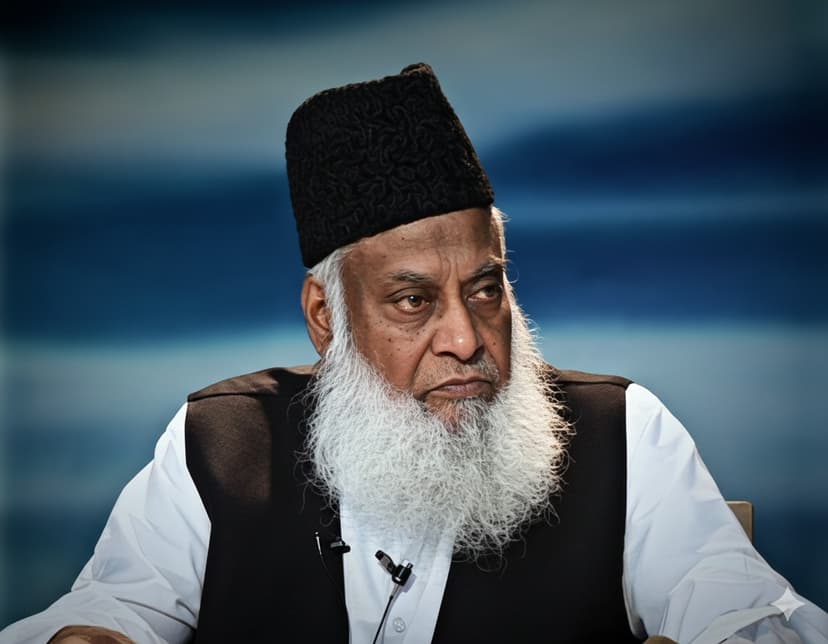
A physician who gave up his practice to revive the Qur'an.
Dr. Israr Ahmad was the second son of a government servant, born on April 26, 1932, in Hisar, a district of East Punjab, which is now a part of Haryana, India. He graduated from King Edward Medical College, Lahore, in 1954 and later received his Masters in Islamic Studies from the University of Karachi in 1965.
He came under the influence of Allama Iqbal and Maulana Abul A'la Maududi as a young student, worked briefly for the Muslim Student's Federation in the Independence Movement and, following the creation of Pakistan in 1947, for the Islami Jami'yat-e-Talaba and then for the Jama'at-e-Islami.
Dr. Israr Ahmad resigned from the Jama'at in April 1957 because of its involvement in electoral politics, which he believed was irreconcilable with the revolutionary methodology adopted by the Jama'at in the pre-1947 period.
While still a student and an activist of the Islami Jami'yat-e-Talaba, he gained considerable fame as a Mudarris, or teacher, of the Holy Qur'an. Especially after 1965 he invested the better part of his physical and intellectual abilities in the learning and teaching of Qur'anic wisdom.
He wrote a significant tract in 1967 explaining his basic thought: that an Islamic Renaissance is possible only by revitalizing the Iman among the Muslims, particularly their intelligentsia. This tract is available in English as Islamic Renaissance: The Real Task Ahead.
He gave up his thriving medical practice in 1971 to launch a full-fledged movement for the revival of Islam. As a result, the Markazi Anjuman Khuddam-ul-Qur'an Lahore was established in 1972, Tanzeem-e-Islami was founded in 1975, and Tahreek-e-Khilafat Pakistan was launched in 1991.
Dr. Israr Ahmad first appeared on Pakistan Television in 1978 in a program called Al-Kitab, followed by Alif Lam Meem, Rasool-e-Kamil, Umm-ul-Kitab and the most popular religious program in the history of Pakistan Television, Al-Huda, which made him a household name throughout the country.
He has to his credit over 60 Urdu books on topics related to Islam and Pakistan, 9 of which have been translated into English and other languages. Throughout his life he was engaged in reviving the Qur'an-centered world-view and in practically reforming society, with the ultimate objective of establishing the System of Khilafah.